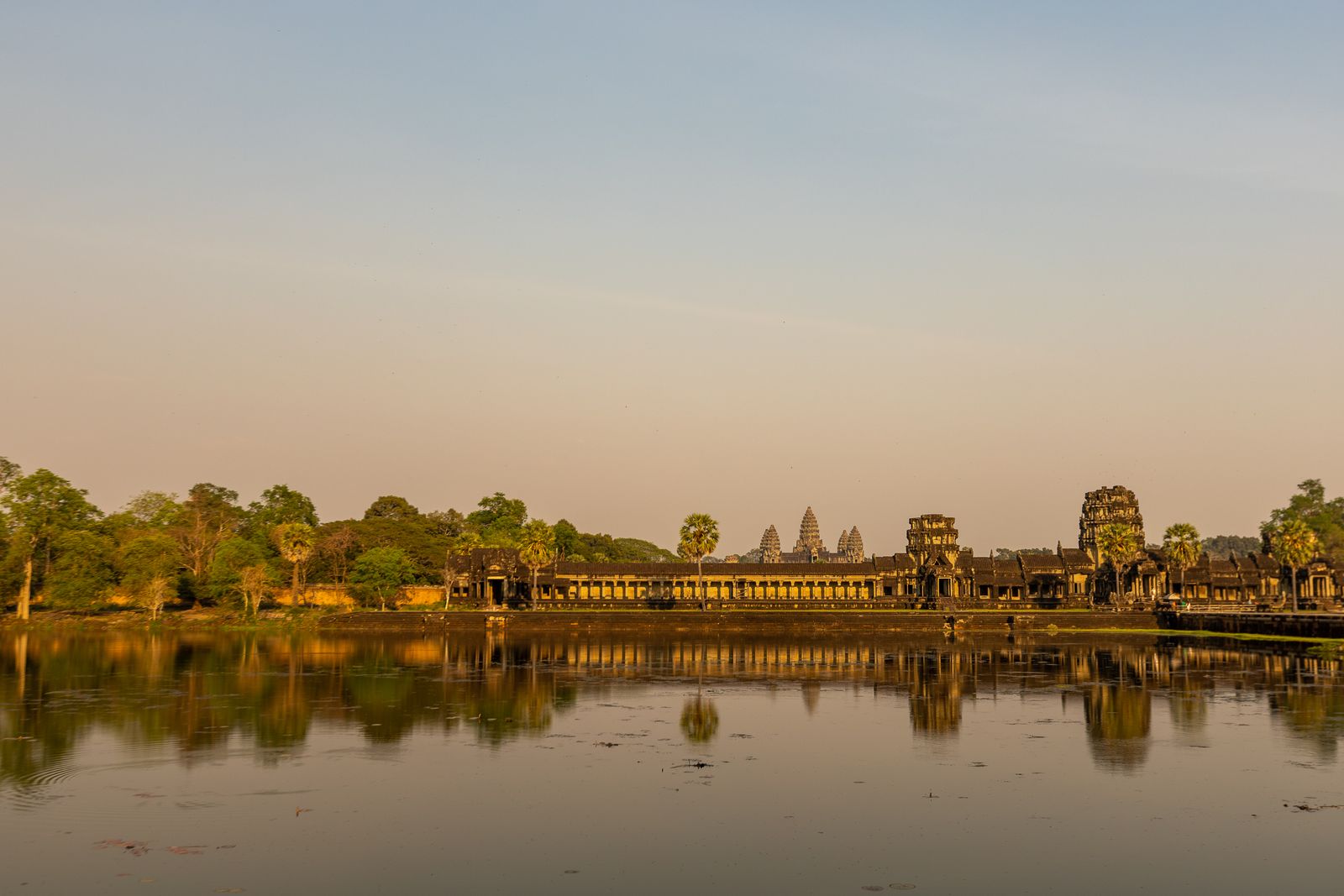
Angkor Wat at sunrise — worth the 4:30am alarm, once.
Angkor is the reason most people come to Cambodia, and Siem Reap is the town that feeds, houses and tuk-tuks them there. The temples are not complicated once someone lays out the system: one pass, two classic circuits, an early start, and a driver who knows the order. Here's the whole thing, plainly — plus the town beyond Pub Street and the new airport nobody's old guidebook mentions.
Last updated: October 19, 2026
Quick answer
Base yourself in Siem Reap town — the park entrance is about 15 minutes away by tuk-tuk. Buy the Angkor Pass: $37 for 1 day, $62 for 3 days, $72 for 7 days, from the official Angkor Enterprise ticket office or its online store only. The 3-day pass is the sweet spot for most first visits (days don't have to be consecutive). Do the small circuit first (Angkor Wat, Bayon, Ta Prohm), the grand circuit second, and get up for sunrise at Angkor Wat once — leave town by 4:30am with a pass bought the day before. Flying in? You'll land at the new SAI airport, about 45–50 km from town, not the old one near the temples.
The Angkor Pass: prices and rules
Every foreign visitor needs an Angkor Pass to enter the archaeological park — it's checked at the park gates and again at individual temples, and your photo is printed on it, so it can't be shared or resold. Prices, as published by Angkor Enterprise:
Pass
Price
How it works
1 day
$37
Valid on the day of use only
3 days
$62
Any 3 days within a 7-day window — days need not be consecutive
7 days
$72
Any 7 days within a 30-day window — days need not be consecutive
Where to buy: the official Angkor Enterprise ticket centre on Road 60, a few kilometres from town on the way to the park, or the official Angkor Enterprise online store. Passes from resellers, hotels or random websites are not valid — the official channels are the only ones. $2 from every pass goes to the Kantha Bopha children's hospitals.
The day-before trick: a pass bought late in the afternoon (after about 4:45pm) is generally stamped to start the next day — and lets you into the park that same evening for sunset without burning a day. It also means no ticket queue before dawn on your sunrise morning.
Children: under-12s enter free — bring their passport as proof of age.
Hours: park checkpoints open at 5:00am. Most temples open around 7:30am and close around 5:30pm; Angkor Wat itself opens at 5:00am for sunrise. The upper level (Bakan) opens later, closes on Buddhist holy days, and doesn't admit under-12s.
Beyond the park: some outlying sites carry separate tickets — recent Angkor Enterprise listings price Beng Mealea at $10 and Koh Ker at $15, and Phnom Kulen (the waterfall mountain) is around $20. Check the current list when you buy; what's bundled changes.
Prices and window rules change occasionally — this page is dated at the top, and the ticket office board is the final word.
Sunrise at Angkor Wat, without the rookie mistakes
Sunrise behind the five towers, reflected in the lily ponds, is the famous shot — and on a clear morning it earns the hype. Doing it well is mostly logistics:
Buy the pass the day before (see the 4:45pm trick above). Queuing at the ticket office at 4:45am with several hundred of your closest friends is the classic own-goal.
Leave town by about 4:30am. Your tuk-tuk driver will suggest the time — they're right; they do this daily. Bring a phone torch for the causeway; it's properly dark.
Head for the ponds inside the western entrance. The northern (left-hand) pond gives the classic reflection and fills first; the southern pond is the quieter alternative.
Don't leave with the crowd. When the sun's up, most people file out to breakfast. Walk into the temple instead — you'll have the galleries nearly to yourself for an hour, in soft light, before the day groups arrive. Eat after.
Do it once, early in your pass. Sunrise is a one-per-trip experience for most people; save the other mornings for unhurried starts. For sunset, Phnom Bakheng is the famous hilltop spot (numbers up top are capped — go early) and Pre Rup is the calmer alternative.
The circuits: which temples, in what order
The park's temples are strung along two loop roads, and the loops are how everyone — drivers, tours, guidebooks — organises a day. Your driver will know them by name; you just pick the day.
Day 1 — the Small Circuit (the essentials, ~17 km loop)
Angkor Wat — the big one. The largest religious monument on Earth, built in the early 1100s. Give it 2–3 hours, more if you climb the Bakan (upper level — dress code strictly enforced).
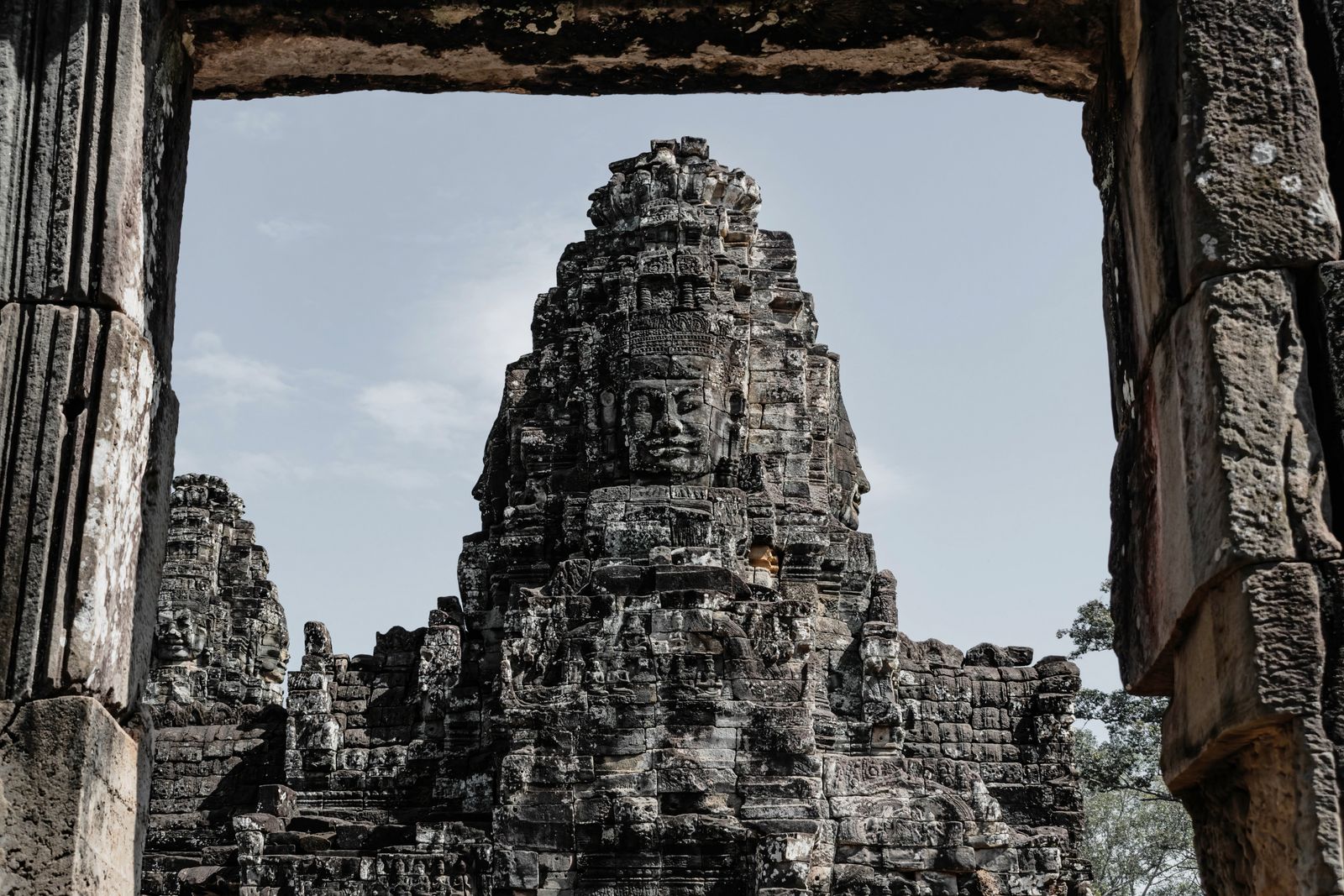
Angkor Thom & Bayon — through the South Gate of the walled city to Bayon, the temple of giant stone faces (200+ of them). Then the Baphuon and the Terrace of the Elephants.
Ta Keo — a steep, unfinished pyramid temple; a leg-burner with views.
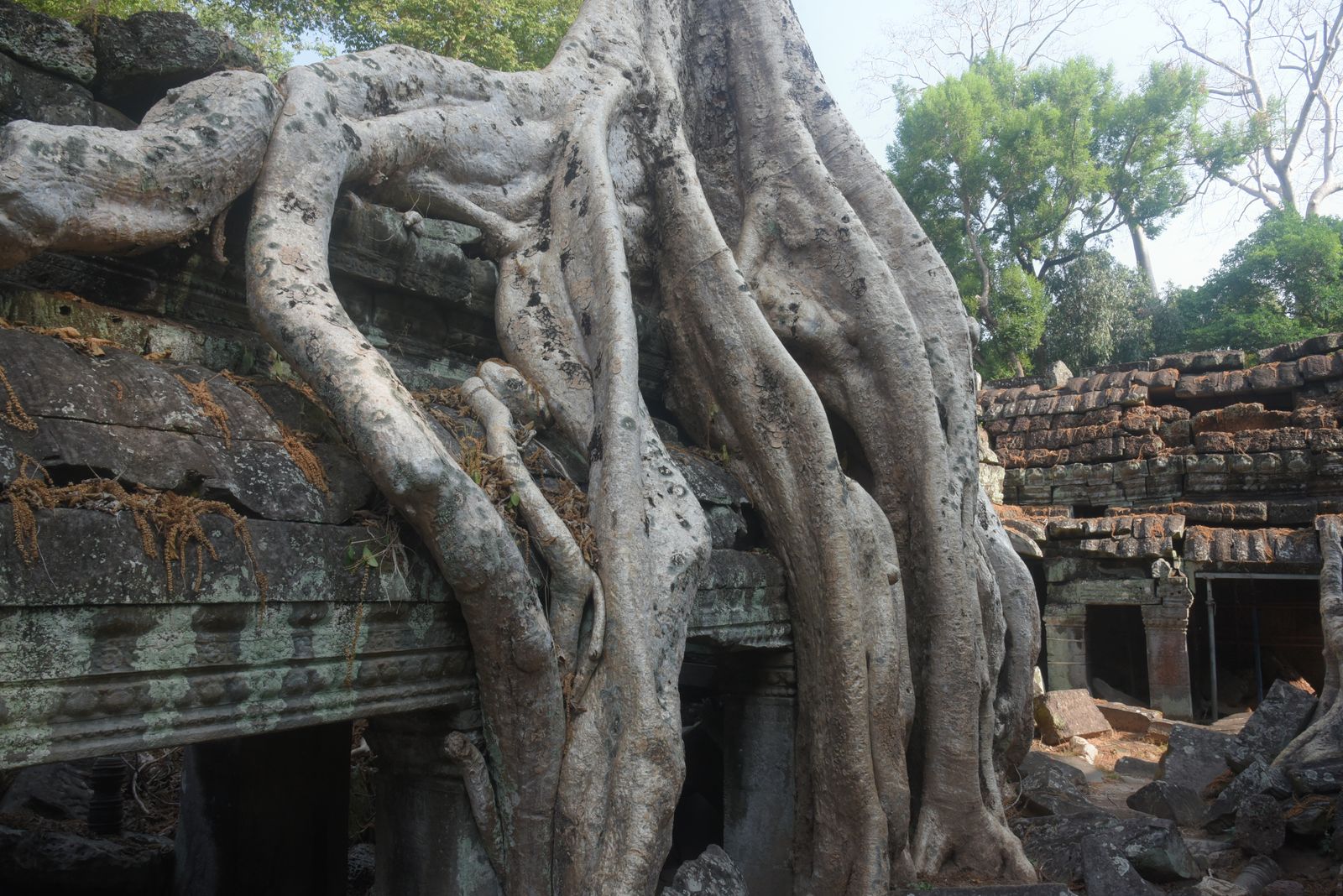
Ta Prohm — the jungle temple, where strangler figs and silk-cotton trees grow through the stonework. Go earlier or later in the day to dodge the worst of the crowds.
Ta Prohm, where the jungle is winning — on the small circuit.
Day 2 — the Grand Circuit (the outer loop, ~26 km)
Preah Khan — a vast, atmospheric monastery complex, partly unrestored, with a famous two-storey pavilion.
Neak Pean — a small temple on an island in a reservoir; the walk out along the causeway is half the pleasure.
Ta Som & East Mebon — quieter stops: a face tower swallowed by a fig tree, and a temple that once stood on an island.
Pre Rup — a brick state temple that glows at golden hour; the standard grand-circuit sunset finish.
Day 3 — further out (where the 3-day pass pays off)
Banteay Srei — about 25 km northeast and the jewel box of Angkor: pink sandstone carved in miniature detail. Go first thing; it's small and the tour buses arrive mid-morning. Covered by the Angkor Pass.
Revisits, done slowly — Bayon in afternoon light, or Angkor Wat's bas-relief galleries with time to actually read them.
Or a rest day in the middle — remember, the 3-day pass doesn't need consecutive days. A pool day between temple days is a legitimate strategy, not laziness.
Getting around the park
Tuk-tuk + driver for the day is the default and the best value: typically $15–25 for the small circuit, more for the grand circuit, sunrise starts, or Banteay Srei (agree the full plan and price before you set off). The driver waits at every temple with — usually — cold water and strong opinions about the order. Hotels and guesthouses can arrange one, or book through the apps.
Private car runs roughly $35–50+ a day and buys you air-conditioning between temples, which by 2pm feels less like luxury and more like strategy.
Licensed guides typically cost around $30–45 a day and transform the visit — the temples' carvings are stories, and a guide reads them to you. Official guides can be booked through hotels and tour desks; check for the official guide licence.
Bicycles and e-bikes suit fit, heat-proof travelers on the small circuit only. The distances and the midday sun are not forgiving, and there's no shame in the tuk-tuk.
Two park practicalities: carry water constantly (a filter bottle earns its place here), and treat sunscreen and a hat as equipment, not accessories — shade is scarce and the stone reflects heat.
Siem Reap town: more than a temple dormitory
Siem Reap would be a pleasant town even without the ruins. The centre is compact and walkable:
Pub Street & the Old Market (Psar Chas) — the neon-lit tourist heart: restaurants, bars and the market's food and souvenir stalls. Loud, fun, and exactly what it looks like. Eat a street or two away for better value.
Wat Bo village, across the river — the quieter, café-and-boutique side of town, and where many longer-stay visitors end up basing themselves.
Night markets — the Angkor Night Market and riverside stalls cover the souvenir circuit; haggle kindly.
Tonlé Sap floating villages — the classic half-day trip out of town. Of the villages, Kampong Phluk (partly stilted, partly floating, with a flooded forest in wet season) is the one most guides rate most highly; Chong Khneas, closest to town, draws the most complaints about add-on pricing. Whichever you choose, agree the full boat price — including any "school visit" detours, which are a well-known upsell — before you leave the dock.
Where to stay
Old Market / Pub Street area — first-timer central: everything walkable, every budget covered, temples 15 minutes away. The liveliest (and least quiet) choice.
Wat Bo & the east bank — calmer streets, good mid-range hotels, a short tuk-tuk or pleasant walk to the centre.
The road to Angkor (Charles de Gaulle Blvd) — the big-resort strip: pools, space, and a head start on the sunrise run, at the cost of a ride into town for dinner.
Getting to Siem Reap: the new airport changes the maths
Siem Reap Angkor International Airport (SAI) opened in October 2023 and replaced the old REP airport entirely — if a guide tells you the airport is 15 minutes from town and the temples, it's describing a closed airport. SAI sits about 45–50 km east of town, built far out partly to keep flight paths away from the temples. Budget the transfer as part of the trip:
Airport shuttle bus — around $8–9 per person to a central stop in town; the budget pick for solo travelers with light luggage.
Fixed-rate taxi / pre-booked car — around $30–35 per vehicle from the airport desk; hotels can also send a car. The ride takes roughly 45–60 minutes.
Tuk-tuk — around $20–25, but it's an hour-plus in open air after a flight; cars earn their premium on this one.
For departures, leave town about 3 hours before an international flight — an hour for the road, two for the airport.
Coming overland instead? Buses and minivans run from Phnom Penh (about 5.5–6.5 hours), and there are direct flights from Phnom Penh, Bangkok and other regional hubs into SAI. See Getting Around for the route-by-route breakdown. And if Siem Reap is your arrival point in Cambodia, our e-Arrival guide and visa on arrival walkthrough cover the airport formalities, and the insurance guide covers the clause that matters if you plan to rent a scooter in town.
Bayon, in the heart of Angkor Thom — save it some unhurried time.
Frequently asked questions
How much is the Angkor Pass in 2026?
The Angkor Pass costs $37 for 1 day, $62 for 3 days and $72 for 7 days. The 3-day pass can be used on any three days within a 7-day window, and the 7-day pass on any seven days within 30 days — the days don't have to be consecutive. Buy from the official Angkor Enterprise ticket office on Road 60 or its official online store; passes sold by resellers are not valid. Children under 12 enter free with proof of age.
How many days do you need at Angkor?
Three temple days is the sweet spot for most first-timers: one for the small circuit highlights, one for sunrise plus the grand circuit, and one for Banteay Srei and anything you want to revisit slowly. One long day can cover Angkor Wat, Bayon and Ta Prohm if you start at dawn, but it's a sprint. Two days is a reasonable minimum.
What time should I leave for Angkor Wat sunrise?
Leave Siem Reap town by about 4:30am. The park checkpoints open at 5:00am and the sky starts colouring 30–40 minutes before the sun appears; the best spots at the reflecting ponds fill early in high season. Buy your pass the day before — a pass bought late in the afternoon (after about 4:45pm) is generally stamped to start the next day and lets you in for that evening's sunset without using up a day.
Can you visit Angkor without a guided tour?
Yes. The standard independent setup is an Angkor Pass plus a tuk-tuk driver hired for the day (typically $15–25 for the small circuit) who waits at each temple. A licensed guide adds a lot of context — the carvings are a library, not just decoration — and official guides typically run around $30–45 a day. Neither the pass nor checkpoints require you to be on a tour.
Is there a dress code for Angkor Wat?
Yes, and it's enforced: shoulders and knees must be covered to enter the temples, and staff will turn people away — especially at the Bakan, Angkor Wat's upper level, where the rules are strictest (it's also closed on Buddhist holy days and to children under 12). Light, loose clothing, a hat, sunscreen and plenty of water handle the rest; there is very little shade at midday.
How far is Siem Reap's new airport (SAI) from town?
Siem Reap Angkor International Airport (SAI), which replaced the old airport in October 2023, is about 45–50 km east of town — roughly 45 to 60 minutes by car. The airport shuttle bus runs to a central stop in town for around $8–9 per person; fixed-rate taxis are around $30–35 per vehicle; tuk-tuks do the run for around $20–25 but take an hour or more in the open air. Old guides quoting a 15-minute airport ride are describing the closed REP airport.
Most trips pair Siem Reap with the capital: see our Phnom Penh guide next, or browse the Places hub for the rest of the country.
Cambodia, straight to your inbox 📬
One short email a week with what actually changed on the ground — no fluff, no spam.
💸 Best travel deals we find🛂 Visa rule changes, fast🧭 New guides & honest reviews first
Free forever · One email a week · Unsubscribe anytime
Get Cambodia in your inbox 📬
Visa rule changes, the best travel deals we find, and new guides — once a week, no spam.
 Wander Cambodia