Last updated: November 10, 2026 · By Wander Cambodia
 By Sophea Khim · Host & Editor, Wander Cambodia
Banlung is the capital of Ratanakiri, Cambodia's wild northeast — a small, red-dust town of roughly 17,000 people that most itineraries skip, and that rewards everyone who makes the effort. The draw is not temples. It is a volcanic crater lake you can swim in before breakfast, three waterfalls within a short ride of the market, jungle that still feels like jungle, and the culture of the Khmer Loeu — the Indigenous peoples who have lived in these hills far longer than the roads have existed. This guide covers what to do, how long to stay, and the honest cost of getting here: a full day on the road, each way.
Most of Cambodia travel runs on a familiar loop: Phnom Penh, Siem Reap, the south coast. Ratanakiri breaks the pattern. The province borders both Vietnam and Laos, the hills roll instead of flattening into rice plain, and the population is sparse — under 200,000 people in a province the size of a small country. Banlung itself grew up around its central market, near the naga roundabout at the heart of town, and it still feels like a frontier market town rather than a tourist centre. That is the appeal and the trade-off in one sentence: fewer services, thinner English, cheaper everything — and a version of Cambodia that the main loop left behind decades ago.
Give it time. Travellers who rush Banlung in a day and a night mostly remember the bus. Travellers who stay three or four days remember the lake at dawn, when the mist is still on the water and nobody else is there. If you are building a longer route, Banlung pairs naturally with Kratie on the Mekong and with Mondulkiri to the south — the three together make Cambodia's northeast loop, the best off-the-main-trail circuit in the country.
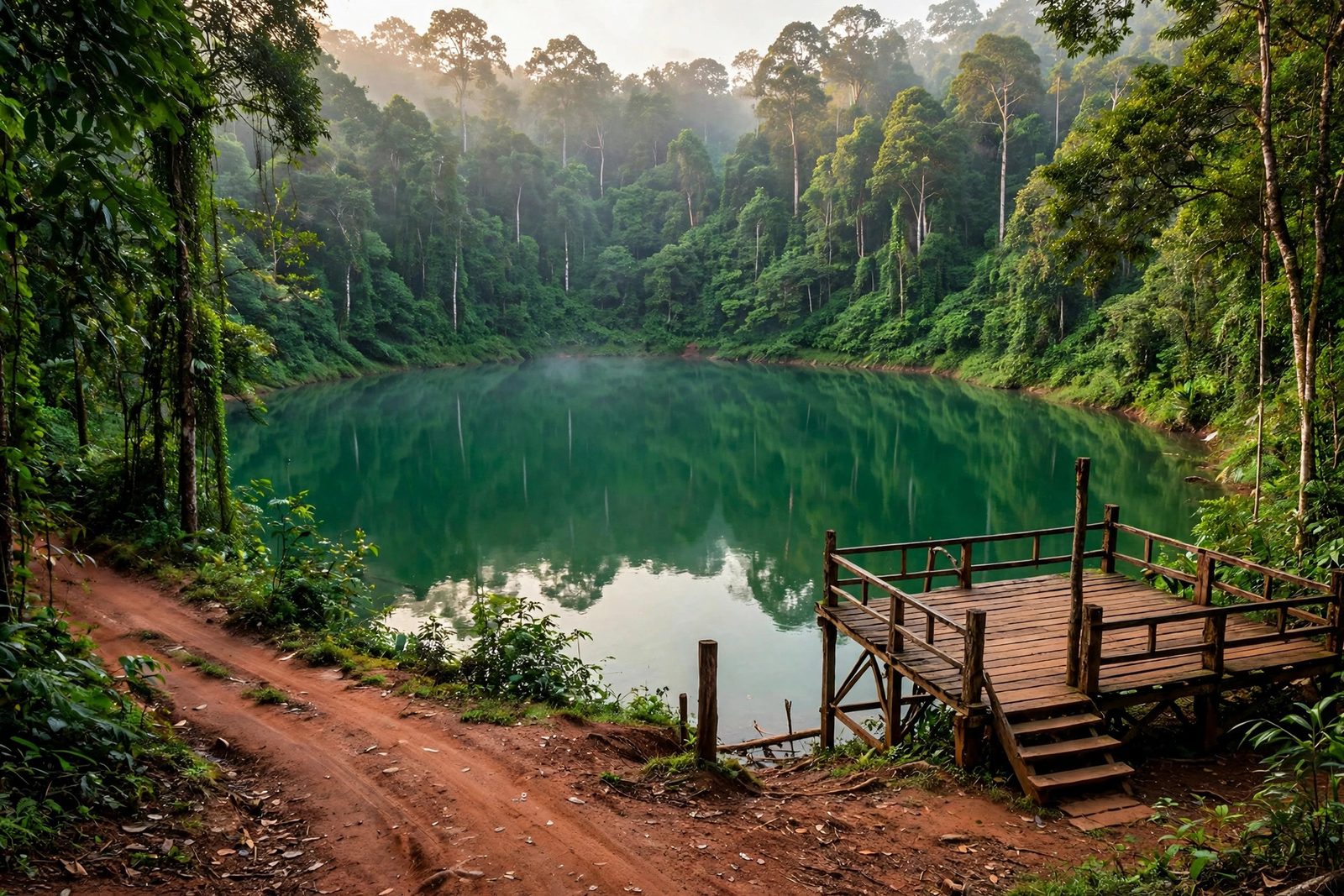
Boeng Yeak Laom is the reason Banlung exists on any map at all. About 5 kilometres east of town, a volcanic eruption thousands of years ago left a crater that filled with water so clear and so clean that it is often described as one of the cleanest crater lakes in Southeast Asia. The lake is almost perfectly circular, roughly 800 metres across and up to about 48 metres deep, ringed by dense forest full of birds. A walking path of about 3 kilometres circles the shore in the shade.
Practically: ride out in the early morning, pay the small entrance fee at the gate, swim from the wooden platforms, and walk the loop before the midday heat. The lake is sacred to the Tampoun people, who manage it as a community-protected area — treat it that way. Swim where the platforms indicate, take litter back with you, and keep behaviour around the shore respectful. Late afternoon is the second-best window: the light goes gold through the trees and day-trippers have gone home.
Banlung's waterfalls are close enough to combine into one unhurried day by motorbike or tuk-tuk, and each has a different character. Cha Ong, about 9 kilometres from town, is the tallest and most visited — a cascade dropping roughly 18 to 25 metres over a rock face you can walk behind in places. Ka Chanh, around 6 to 7 kilometres south, is the most accessible, set in lush vegetation on the Kontung stream with a swing bridge that adds a bit of theatre. Katieng, a little further on a similar route, is a multi-tier fall in evergreen forest with a cave tucked behind the curtain of water and pools that invite a swim.
Expect a small entrance fee at each site and red-dirt roads that are easy in the dry season and slippery after rain. Water flow is the seasonal trade: the falls are at their most dramatic late in and just after the rainy season, and at their gentlest in March and April. Even at low flow, the forest settings carry the day — this is a swim-and-shade circuit, not a checklist sprint.
North of Banlung, Virachey National Park protects one of the largest remaining wilderness areas in Cambodia — deep forest running up to the Laos and Vietnam borders. Multi-day treks into Virachey are arranged in Banlung with park rangers and local guides: expect river crossings, hammock camps, and wildlife that you will mostly hear rather than see. This is not a casual day trip and should not be sold as one. Book through a reputable local operator, go in the dry season unless you specifically want the wet jungle at full intensity, and budget for the park and guide fees as quoted at the time — they change, and any price printed in an old blog post is a guess today.
Ratanakiri is home to several Khmer Loeu groups, including Tampoun, Jarai, Kreung and Brao communities, each with its own language and traditions. Village visits around Banlung — including the communities near Voen Sai, on the road toward the Se San river — can be a genuine exchange or an awkward photo exercise, and the difference is the guide. Go with a local guide from the community where possible, ask before photographing people, buy crafts at the price asked when you can, and remember that cemeteries and sacred sites are not attractions. Banlung's market is the low-key alternative: hill-tribe crafts, local coffee and the famous Ratanakiri gemstones all pass through it, and nobody's home becomes a stage set.
There is no shortcut. Banlung has no commercial airport service, so everyone arrives by road, and from Phnom Penh that means a full travel day — commonly eight hours or more by bus or minivan, on a route that runs up through Kratie and Stung Treng before turning east. Overnight and early-morning departures both exist; the early start is the better choice, because arriving before dark makes finding your guesthouse and your bearings far easier. Coming from Kratie shortens the day considerably, and coming from Mondulkiri turns the journey into part of the northeast loop rather than a there-and-back slog.
Roads in Ratanakiri itself are a mix of sealed highway and red dirt. In the dry season a rented motorbike opens up the waterfalls and the lake on your own schedule; in the wet season, hire the tuk-tuk or the car and let someone who knows the mud do the driving. Either way, build slack into the plan — this is the province where a tight connection goes to die, cheerfully.
Most traveller accommodation sits either in town near the market or out on the road toward Yeak Laom, where several guesthouses and small resorts trade a ten-minute ride for gardens and quiet. Banlung is cheap by Cambodian standards: simple guesthouse rooms, local food and motorbike days all cost noticeably less than the same things in Siem Reap, and a budget of roughly $20–40 a day covers a comfortable backpacker version of the town. Eat where the market eats — noodle soups and grilled meats in town, Khmer staples everywhere — and try the local coffee, grown in these highlands.
Three nights is the minimum that does Banlung justice: one day for the lake and waterfalls, one for a village or market day, one spare for weather and slowness. Four or five nights turns it into what it should be — the unhurried heart of a northeast loop, not a detour you apologise for.
November to February brings the coolest, driest weather — the classic window, when dirt roads behave and nights can be genuinely cool. March to May is hot and dusty, with waterfalls at their thinnest. The rainy season, roughly June to October, is the connoisseur's trade: everything is green, the falls are roaring, the lake is at its fullest — and the dirt roads earn their reputation. Our month-by-month logic in when is the best time to visit Cambodia applies here with the volume turned up: in Ratanakiri, the seasons are not a detail, they are the itinerary.
Distances and journey times are typical dry-season figures checked November 2026; wet-season road times run longer. Entrance and park fees change without notice — treat any exact fee quoted elsewhere with suspicion and carry small cash.
Yes, if you have at least three days there and want the Cambodia most visitors never see: a swimmable volcanic crater lake, three waterfalls in easy reach, red-dirt roads and Indigenous Khmer Loeu culture. It is a full day of road travel each way, so it does not work as a quick add-on to a one-week trip.
Yeak Laom is a near-perfectly circular volcanic crater lake about 5 kilometres east of Banlung, roughly 800 metres across and very deep, surrounded by protected forest. It is sacred to the local Tampoun people, you can swim from the wooden platforms, and a shaded path of about 3 kilometres circles the shore.
November to February is the most comfortable window: dry roads, cooler nights and waterfalls still running from the wet season. The rainy season (roughly June to October) makes the waterfalls strongest and the hills greenest, but dirt roads get muddy and journeys take longer.
By road. There is no commercial airport serving Banlung, so the route is bus or minivan from Phnom Penh via Kratie and Stung Treng, or from Kratie or Mondulkiri as part of a northeast loop. Plan on a full travel day from the capital and book a morning departure.
Sen Monorom is Banlung’s southern neighbour on the northeast loop — Phnom Penh to Sen Monorom covers the road in, and the two towns connect in about 3.5 hours.
One short email a week with what actually changed on the ground — no fluff, no spam.
Free forever · One email a week · Unsubscribe anytime
Visa rule changes, the best travel deals we find, and new guides — once a week, no spam.
Free forever · Unsubscribe anytime
 Wander Cambodia