Last updated: November 24, 2026 · By Wander Cambodia
 By Sophea Khim · Host & Editor, Wander Cambodia
You need both. Credit cards (Visa and Mastercard) work reliably at hotels, malls, supermarkets and bigger restaurants in Phnom Penh and Siem Reap, sometimes with a surcharge of around 3%. Almost everything else — markets, street food, tuk-tuks, small guesthouses, rural towns and the islands — is cash only, paid in US dollars and Cambodian riel. Carry a card for the big bills and a clean, small-note cash float for daily life, and withdraw at city ATMs before heading anywhere rural.
Short version: bring both, and understand which one does which job. Your card will pay the hotel, the mall and the nicer dinners in the two big tourist cities. Everything else in Cambodia — the market stall, the tuk-tuk, the beach shack, the countryside guesthouse — runs on cash, and no amount of tapping will change that this year. This page draws the line precisely, so you carry the right mix instead of discovering the boundary at a market stall with your hands full.
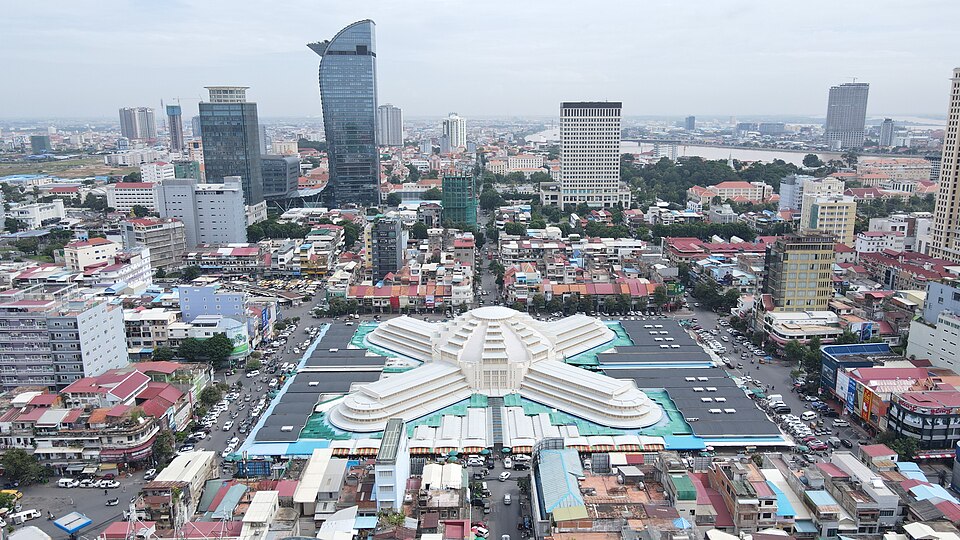
In Phnom Penh and Siem Reap, the formal economy is fully carded. International and mid-range hotels take Visa and Mastercard at the desk and online; the malls and supermarkets run cards at every till; chain coffee shops, better restaurants and the airlines are card-normal. Contactless works where the terminal is modern. If your trip were only those two cities and only their formal businesses, you could nearly do it on a card — and many business travellers do. The trap is that a Cambodia trip is never only that. The card economy ends exactly where the interesting part of the day begins: the market under the dome in our photograph, the food stall street, the boat ticket, the countryside. Which is why the honest answer to the question in the title is not a yes or a no, but a division of labour.
Cash runs: all markets and street food; tuk-tuks and motos, including the app rides if you choose cash payment; small and family guesthouses; local restaurants; temple and site donations and small entrance fees; boats to the islands and everything on the islands themselves; and effectively the whole country outside the two main cities and a handful of resort desks. The cash itself is two currencies working as one — dollars for anything of size, riel flowing back as change and covering the small end — and the system is smoother than it sounds once you stop resisting it. Two rules carry most of the weight. Keep your dollar notes clean and untorn, because a damaged bill is refused everywhere and there is no appeal. And keep a working float of small money — ones, fives, and riel — because the commonest cash friction in Cambodia is not having no money, it is having only a twenty. Our money in Cambodia guide is the full manual, and dollars or riel settles which hand to reach with.
Two things catch card-carriers out. The first is the surcharge: businesses that accept cards often add a percentage — around 3% is common — for the privilege, disclosed or not. On a coffee it is nothing; on a week's hotel bill it is a dinner. Ask, and decide with the number in front of you; sometimes the cash price is simply the real price. The second is the QR code that is printed on every counter in the country. It looks like the phone-payment future, and for Cambodians it is — the KHQR system moves money between local bank accounts instantly, which is why even a coconut seller has a code. But it runs on Cambodian banking apps, and a visitor without a local account mostly cannot ride it. Do not stand at a stall assuming your home banking app will save you. Your payment technology, as a visitor, is a card for the formal economy and folded notes for the real one.
Here is the working setup, the one that survives a whole trip. One main card and one backup, from different networks if you can, kept in different places. A cash float built at city ATMs — they dispense dollars in Phnom Penh and Siem Reap and stand in every sizeable town — sized to the days until your next city, doubled for the islands, where our Koh Rong ferry guide explains why the mainland is your last cash point. Small notes protected like documents, because in cash country they are. And the card spent where it is strong: hotels, flights, the big restaurant, the emergency. That division — card for the pillars, cash for the life between them — is how Cambodia actually works, and a trip planned on it never has the awkward moment at the till.
The point is not that Cambodia is behind. Its own phone-payment system is ahead of plenty of richer countries; it is simply a system built for the people who live here, and you are a guest in it. Carry the mix, keep the notes clean, and money stops being a topic — which, on a trip, is the highest praise a currency system can earn. For the budget that cash has to cover, see how much money you need for Cambodia.
Yes — in the places built for them. Hotels, malls, supermarkets, airlines and bigger restaurants in Phnom Penh and Siem Reap take Visa and Mastercard as a matter of routine. But Cambodia still runs on cash for most of daily life: markets, street food, tuk-tuks, small guesthouses, rural towns and the islands are cash businesses. The working answer is both — card for the big bills, cash for everything else.
Often, yes. Smaller hotels and shops that accept cards commonly add a percentage — around 3% is typical — to cover their bank fees, and some quote prices in dollars but settle cards in riel at their own rate. Ask before you hand the card over; on a large hotel bill the surcharge is real money, and paying cash can be the cheaper route.
You will see QR payment codes everywhere — on market stalls, tuk-tuks, cafe counters. That system, KHQR, runs through Cambodian bank accounts and local banking apps, which most visitors do not have. A few international wallets interoperate in places, but do not build your trip on it: as a visitor, your phone payment is the exception, and cash is the system.
US dollars for the larger amounts and Cambodian riel for the small end — change, markets, moto rides, water. Dollars must be clean and untorn; damaged notes are refused, and the refusal is final. ATMs in the cities dispense dollars and are the practical way to restock; our money in Cambodia guide covers denominations, change and the two-currency dance in full.
Less and less, the further you go. Battambang and Kampot have card-accepting hotels and a few restaurants; the islands, small towns and everywhere rural are cash economies with an ATM if you are lucky. Rule of thumb: the smaller the place, the more your card is a decorative rectangle. Withdraw in the city before you leave it.
One short email a week with what actually changed on the ground — no fluff, no spam.
Free forever · One email a week · Unsubscribe anytime
Visa rule changes, the best travel deals we find, and new guides — once a week, no spam.
Free forever · Unsubscribe anytime
 Wander Cambodia