Last updated: November 24, 2026 · By Wander Cambodia
 By Sophea Khim · Host & Editor, Wander Cambodia
The bamboo train is the most famous vehicle in Cambodia, and the most misunderstood. It was never built for tourists. It was built by the people around Battambang to move rice, goods and themselves along a colonial railway that the trains had abandoned — a bamboo platform on two sets of wheels, powered by a small engine, that could be lifted off the track in pieces when a real train, or another norry, came the other way. This page explains what it was, what the ride that runs today actually is, and how to enjoy it with your eyes open.
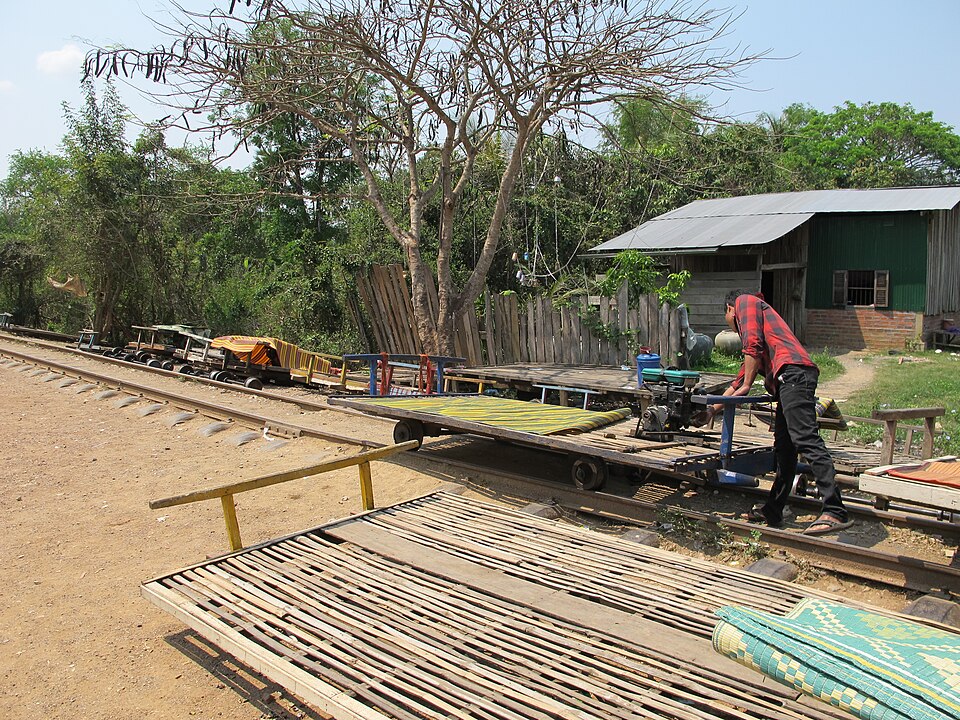
The name first: in Khmer it is a norry, from the French word for a lorry, and the machine is exactly as simple as our photograph shows. A platform of bamboo slats, roughly three metres long. Two bogies — heavy steel wheel sets, like barbells — that sit on the rails. A small engine at the back, driving the rear bogie with a belt, and a driver who controls speed with a lever and stops the thing with a brake and experience. There is nothing else. No carriage, no suspension, no roof. That simplicity was the whole point: a norry could be assembled in minutes, carried loads a motorbike could not, ran on fuel a village could afford, and when two norries met on the single track, the lighter one was dismantled, lifted off, and rebuilt on the other side of the passing one. Right of way belonged to the heavier load.
For years, norries were the real public transport of the countryside northwest of Battambang and in pockets of the country wherever rails survived and trains did not. They carried farmers, market goods, schoolchildren and the occasional traveller at speeds that could reach a rattling 40–50km/h on good track — fast enough that a ride on the original line was genuinely thrilling, wind and noise and the track joints hammering underneath the bamboo. Visitors discovered it, word spread, and the norry became a Cambodia rite of passage. Then the thing that had to happen happened: Cambodia rebuilt its railways. Real trains need empty tracks, the northern line was restored to service, and the original norry running — on the line out of Battambang that most visitors rode — came to an end. Any page that still describes the old line as working transport is describing a Cambodia that has gone.
The bamboo train did not die; it moved. The ride operating now runs on a short stretch of track in the countryside outside Battambang, in the area of Phnom Banan, the Angkor-era hill temple south of the city. It is the same machine, run by drivers from the same norry world, on an out-and-back run of a few kilometres through fields and villages, with a pause at the far end where stalls sell drinks and souvenirs. Be clear-eyed about the difference, because it decides whether you love it or feel cheated: today's ride is a short, joyful demonstration of an ingenious machine, not a journey. The speed is modest, the track is a fragment, and the dismantling ceremony now happens for the camera rather than for a freight train. Taken on those terms — fifteen to thirty minutes of rattling through rice country on a bamboo deck, then a temple on a hill — it is a good morning. Taken as the legendary transport of the old line, it will feel small. Our Battambang guide puts it in the day's running order.
The ride pairs naturally with its own neighbourhood. Phnom Banan, the 11th-century temple on its hill, is the same trip out of town: climb the temple's steep steps in the cool of the morning, ride the norry while the day is still young, and be back in Battambang for lunch. Drivers in town know the circuit well — hire a tuk-tuk for the half day and agree the whole loop, including waiting time, before you set off, the same rule as every hired ride in Cambodia. At the station, confirm the fare and what it covers before the platform rolls: fares in recent years have been reported at about $5 a person, sometimes priced per platform for a group, and the far-end stalls are a business, so a polite no is a complete sentence if you do not want a drink or a scarf. Take water, take sun protection — there is no shade on a bamboo platform — and sit low in the middle of the deck, where the ride is kindest.
It would be easy to file the bamboo train as a novelty and skip it, and plenty of travellers do. That misses what the machine is evidence of. The norry is what a country builds when it has been left with broken infrastructure and no money: not a complaint, but a vehicle — designed from bamboo, scrap steel and a motorbike engine, maintained by the people who rode it, and good enough to run a rural transport network for years. The drivers who run the ride today are the inheritors of that, and the fare you pay them is one of the more direct ways a visitor's money reaches the countryside. Ride it for the rattle and the wind, by all means. But ride it knowing what you are sitting on.
Battambang rewards the traveller who gives it more than the train. The city itself — colonial streets, the river, the art scene — is covered in our Battambang guide, the road in is covered in Phnom Penh to Battambang and Siem Reap to Battambang, and the norry makes the most sense as the countryside chapter of that stay: temple hill in the morning, bamboo deck before lunch, and the slow city for the evening.
A norry: an improvised rail vehicle from Battambang province. A light bamboo platform, about three metres long, sits on two steel bogies — the barbell-like wheel sets in our photograph — with a small motorcycle or tractor engine driving the rear bogie by belt. It was built by local people to move themselves and their goods along a railway that had almost no trains on it.
Yes, as a visitor ride — but understand what changed. The original norry lines were working local transport, and they ended as Cambodia's real railway was rebuilt and regular trains returned. The ride that operates today runs on a short relocated stretch of track in the countryside outside Battambang, in the Phnom Banan area, and exists for visitors. It is the genuine machine and the genuine idea, run as an attraction.
Travel write-ups in recent years have put the ride at about $5 a person, with the fare set at the station and sometimes charged per platform for small groups. Prices and arrangements change, so confirm the fare before you climb on — and agree it clearly, including whether it covers the return run, because the track is out-and-back.
The run itself is short — a few kilometres of track, out and back, with a pause at the far end where there are usually drink and souvenir stalls. Count it as a half-hour experience inside a countryside trip rather than a journey: most visitors combine it with Phnom Banan temple and the villages and scenery on that side of Battambang.
It is an open bamboo platform on rails, with no seatbelts, no sides and a driver who brakes with a lever and judgement. Rides run at a modest pace and the same drivers have run them for years, but it is not a regulated railway ride and you should treat it as what it is: sit low, hold on, keep hands and feet inside the platform, and skip it if the machinery or the weather looks wrong to you.
One short email a week with what actually changed on the ground — no fluff, no spam.
Free forever · One email a week · Unsubscribe anytime
Visa rule changes, the best travel deals we find, and new guides — once a week, no spam.
Free forever · Unsubscribe anytime
 Wander Cambodia