Last updated: November 24, 2026 · By Wander Cambodia
 By Sophea Khim · Host & Editor, Wander Cambodia
Most travellers pass through Kampong Chhnang at speed, halfway between Phnom Penh and Battambang, and see a dusty junction town. That is a waste of a good stop. The name gives the place away — Kampong Chhnang means Port of Pottery, and the villages around the town have made Cambodia's clay cooking pots for generations. Add floating villages on the Tonle Sap river, countryside temples among the sugar palms, and a town that runs almost entirely for Cambodians, and you have the most honest half day on National Road 5.
Start with the misconception, because it decides how you visit: Kampong Chhnang is not a sight, it is a working town with sights spread around it. There is no single ticket gate, no cluster of attractions in the centre. The pottery is in a village outside town, the floating villages are at the river's edge, the temples are out in the rice country. Which means the visit lives or dies on transport — come with a driver, or hire a tuk-tuk in town for the loop, and the day falls into place. Arrive on a through bus with no plan and you will see the bus station, which is the one part of Kampong Chhnang nobody should judge it by.
The village of Ondong Rossey, a few kilometres from town, is the reason the province is named for pots. Families here dig the local clay, shape pots on kick wheels and by hand, dry them in the sun and fire them in simple kilns — and the pots then travel the whole country, stacked on trucks and boats, because the Cambodian kitchen still runs on clay: the everyday cooking pot, the water jar, the stove. A visit is not a demonstration laid on for tourists. It is a working village that lets you walk through it, watch the stages in order — clay, wheel, drying yard, kiln, finished stacks — and buy at the end for workshop prices. A pot bought here costs very little and means more than anything in a souvenir shop, with one practical warning: clay is heavy and fragile, so buy small, or buy for a home you are driving to rather than a flight you are boarding.
Kampong Chhnang town stands on the Tonle Sap river, downstream of the great lake, and its edge is a working river port: fishing boats, fish traders, and the stilted and floating communities whose houses rise and settle with the water. Small boats take visitors out among the floating houses, and the honest way to do it is the way you would visit any neighbourhood — from the boat, at a respectful distance, understanding that these are homes and workplaces, not exhibits. The scene changes completely with the seasons. In high water the river spreads and the houses float on it; in the dry months the water falls away, the stilts stand exposed over mud, and the fishing economy works the shrinking channels. Our Tonle Sap guide explains the lake's famous flood pulse, and this town is where you see its river end of the story. Go early in the morning if you can: the fish trade is a dawn business, and the river is at its best before the day's heat flattens it.
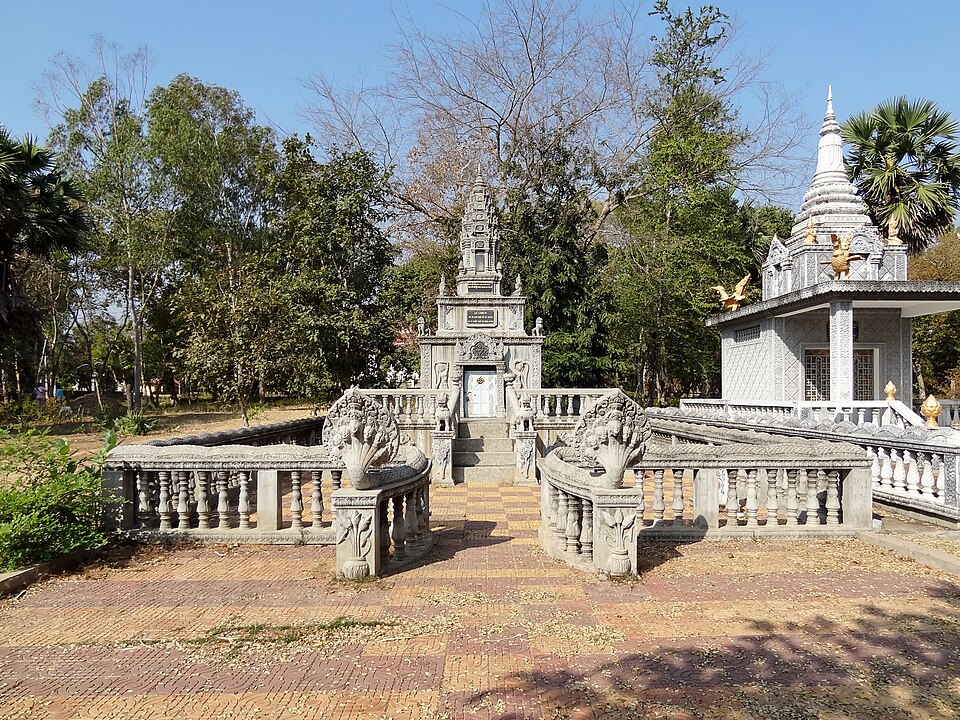
Out among the rice fields and sugar palms stand the province's old temples, and they are the quiet part of the visit — no queues, no ticket booths, often nobody there but the caretaker and the monks. Wat Kampong Tralach Leu, in our photograph, is the best known of them: a carved stone stupa and shrine in a shaded wat compound, the kind of place where the visit is ten minutes of looking and twenty of simply being somewhere calm. Treat these stops as the pause between the pottery and the river rather than as headline sights, dress for a temple, and carry small notes for the donation box. The road out is half the pleasure — flat green country, palm trees, ox carts and village life running at its own speed, the Cambodia that the highway usually hides.
Kampong Chhnang earns its place in three itineraries. First, the overland run between the capital and Battambang: break the journey here for two to three hours — pottery village, an early lunch in town, the river — and the long road day turns into a travel day. Our Phnom Penh to Battambang guide covers that route in full. Second, as a day trip from Phnom Penh with a hired car: out in the morning, the full loop, back by evening, with Oudong, the old capital on the same National Road 5 corridor, as the alternative if temples matter more to you than pottery. Third, for slow travellers crossing the country by local buses, as a one-night stop that shows you a provincial capital with no tourist layer at all — simple guesthouses, market food, and an evening by the river. Eat where the town eats: the market and the stalls around it serve the standard Khmer repertoire at local prices, and the thing to drink is palm juice, sold along the roads out of town in the season.
The point of Kampong Chhnang is that it was never built for you. Angkor was a capital, the islands are a holiday, and this is a town that makes the country's pots and lands its fish, which lets a traveller stand inside ordinary Cambodia for a few hours. Stop properly — village, river, temple, lunch — and the junction town becomes one of the days you describe when people ask what the country was actually like.
Port of Pottery. Chhnang is the Khmer word for a cooking pot, and the town earned the name from the clay pots made in the villages around it — above all Ondong Rossey, where potters still shape and fire pots by hand. If you buy one clay pot in Cambodia, this is the honest place to buy it: from the people who made it.
It sits on National Road 5, roughly 90km northwest of Phnom Penh — about two hours by bus or car in normal traffic, on the way to Battambang. Buses between Phnom Penh and Battambang pass through and can drop you; a private car or a hired driver for the day makes the stops much easier, because the sights are spread around the town rather than in it.
Three things, in this order: the pottery village of Ondong Rossey, where you watch pots thrown, dried and fired and buy them at workshop prices; the floating and stilted villages on the Tonle Sap river at the edge of town, visited by small boat; and the countryside temples, Wat Kampong Tralach Leu among them, out among the rice fields and sugar palms.
For most travellers, no — it works best as a long stop or a half day inside the Phnom Penh to Battambang journey, or as a day trip from the capital with a driver. Stay the night only if you are travelling slowly and want a provincial town evening with almost no other visitors in it, which is its own kind of pleasure.
The dry months, roughly November to April, for the roads out to the pottery village and the temples. The floating villages read differently by season: high water in the late wet season brings the river up to the houses, while the dry season shows the stilts and the mud banks. Both are worth seeing; they are almost two different places.
One short email a week with what actually changed on the ground — no fluff, no spam.
Free forever · One email a week · Unsubscribe anytime
Visa rule changes, the best travel deals we find, and new guides — once a week, no spam.
Free forever · Unsubscribe anytime
 Wander Cambodia