Last updated: November 11, 2026 · By Wander Cambodia
 By Sophea Khim · Host & Editor, Wander Cambodia
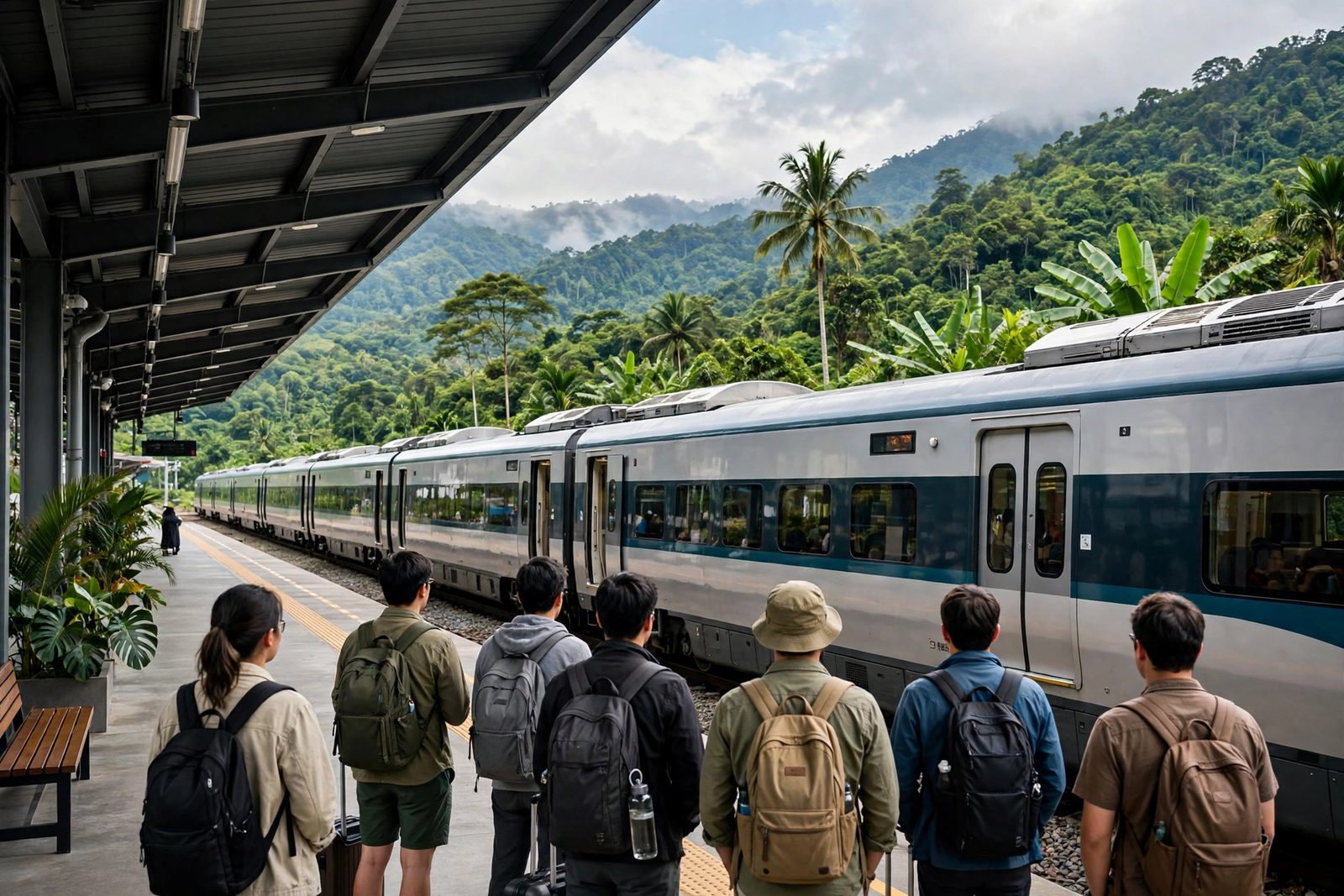
The Laos–China Railway is the best piece of transport infrastructure in mainland Southeast Asia — a fast, modern line running some 420 km from Vientiane through Vang Vieng and Luang Prabang to Boten on the Chinese border, and on to Kunming. It is also, for foreign visitors, the hardest ticket in the region to buy: no normal website, a booking window measured in days, and an official app that older guides describe wrongly. This guide explains how booking actually works in 2026, because the railway is the natural second half of a Cambodia + Laos trip — our two-country itinerary rides it end to end.
Trains run from Vientiane north to Vang Vieng (~1 hour), Luang Prabang (~1 hour 50 minutes from Vientiane), Muang Xay (for Oudomxay) and Boten at the Chinese border. Three families of train use the line: fast C trains (up to 160 km/h — the ones most visitors want), slower, cheaper K trains that stop everywhere, and D trains, the international services between Vientiane and Kunming that take around nine and a half hours and clear both countries' border formalities en route. Fares are set in kip and are still modest: since a rise of about 9% on 1 April 2026, Vientiane to Luang Prabang costs 360,000 kip in second class, 569,000 kip in first and 1,063,000 kip in business class, and the full Vientiane–Boten run is 605,000 kip in second class. Treat any dollar figure you see quoted as approximate — the kip price is the real one.
The official channel is the LCR Ticket app, published by Laos-China Railway Company for iPhone and Android, in Lao, Chinese and English. Install it before you travel. Registration works with an email address — a Lao SIM is not required in current versions, whatever older guides insist (a Lao or Chinese number can be added if you have one, and local travellers often use one). Tickets are issued to named passengers, so you add each traveller's passport details exactly as printed; the same passport is checked at the gate.
Payment inside the app is reported to accept Visa and Mastercard alongside UnionPay, Alipay, WeChat Pay and BCEL One — with the honest caveat that foreign-card payments fail often enough that you should have a backup plan (below) rather than discover it at 06:35 with the last seats going. On success you receive a QR-code ticket: for domestic journeys that QR code plus your passport is all you need at the gate. International services toward China carry a paper-ticket step — collect the physical ticket at the station in your departure country, showing the booking passport.
Everything about this railway is easy except when you may buy. Domestic tickets are released only a few days ahead — the exact number has changed repeatedly since the line opened, and honest 2026 reports put it between 3 and 7 days, with recent travellers finding up to 7. Sales typically open around 06:30 Laos time, and the desirable departures — morning trains out of Vientiane and Luang Prabang above all — can sell out the same day, sometimes within minutes in high season. International D-train tickets open further ahead, roughly two weeks.
The working method: fix your Laos dates first, set the app up completely (account, passengers, payment) before your window opens, check the app for the exact release day for your route, and buy the moment it appears. Build Laos itineraries with a day of slack around the train you most depend on. If your first-choice train is gone, the K trains and the bus network still run — slower, but the trip survives.
Platforms such as 12Go will sell you this train in advance, in English, for a markup — and for most transport in the region we happily use them. Here, understand what you are buying: a reseller does not hold the ticket. It takes your order and buys when the official window opens, so if the train sells out at release, your confirmed-looking booking can still fail. Use a reseller only if the app defeats you, and do not build an unchangeable onward plan on a reseller confirmation. The older fallback still works too: station and downtown ticket offices in Vientiane and Luang Prabang sell tickets for cash with a small service fee (around 20,000 kip), once the same window has opened.
Stations on this line are run more like airports than the Southeast Asian stations you may know: ticket-and-passport checks at the door, security screening, and gates that close before departure. Arrive about 45 minutes early with your passport and QR code. Also budget for geography: the stations sit well outside their town centres — Vientiane's and Luang Prabang's stations both need a real transfer, not a stroll — so book the station run as part of the journey, and keep your Laos arrival paperwork and visa position in order before you ever reach Boten: the railway station there does not reliably offer visa on arrival, and the train will not wait while you sort one out. Sort a Laos eVisa in advance if your crossing needs one — the checkpoint list shows where it is accepted.
1. Assuming you can book a month ahead. You cannot — the window is days, not weeks, and itineraries built on a train you have not yet been allowed to buy need a bus-shaped backup. 2. Registering the app at the station. Account setup, passenger entry and a payment test take minutes you will not have when seats are disappearing at 06:30; do all of it days earlier. 3. A name that does not match the passport. Tickets are passport-named and gate-checked; a nickname or a transposed number is a refused boarding, not a shrug. 4. Treating a reseller confirmation as a ticket. Until a real ticket exists in your name — ideally visible in the LCR app or as a collected paper ticket — your seat is a hope, and onward bookings should stay refundable. 5. Forgetting the station transfer. The train is fast; getting to its out-of-town stations is not. A tight same-hour connection between a bus arrival in town and a train departure across the city fails in ordinary traffic.
From Cambodia, the railway pairs with the overland route through Tropaeng Kreal: cross into Laos there, work north to Vientiane by bus, then let the train do the beautiful part — Vang Vieng and Luang Prabang at speed instead of a day on mountain roads. The full routing, with the border walkthrough, is in our Tropaeng Kreal crossing guide and the Cambodia + Laos itinerary. Flying Phnom Penh to Vientiane and riding the line north is the faster version of the same trip.
Fares and booking-window details checked November 2026 against current railway guides and traveller reports; the window and app rules change often, so confirm your exact date inside the LCR Ticket app before relying on any figure here, ours included.
Use the official LCR Ticket app (by Laos-China Railway Company) and register with your email address — current versions do not require a Lao phone number, despite what older guides say. Add each passenger's passport details, pay in the app, and keep the QR-code ticket. If app payment fails on a foreign card, station ticket offices and downtown ticket offices in Vientiane and Luang Prabang sell tickets for cash for a small fee.
Not far. Domestic tickets are released only a few days before departure — reports through 2026 vary between 3 and 7 days, with recent reports saying up to 7 days, released around 06:30 Laos time. International trains toward China open roughly two weeks ahead. Popular morning departures between Vientiane and Luang Prabang can sell out on the first day, so be ready when your date opens.
12Go is a reseller, not the railway: it takes your booking and buys the ticket when sales open. If the train sells out at release, a reseller booking can fail or be cancelled even after you have paid. Booking direct on the LCR Ticket app is cheaper and more certain; use resellers only as a fallback, and treat their confirmation as provisional until a real ticket with your passport name exists.
One short email a week with what actually changed on the ground — no fluff, no spam.
Free forever · One email a week · Unsubscribe anytime
Visa rule changes, the best travel deals we find, and new guides — once a week, no spam.
Free forever · Unsubscribe anytime
 Wander Cambodia